
Mathematics
Math on Lessons runs from first counting at ages 3 to 5 through every school year to first-year university. It covers number, shape and space, algebra, data and chance, and calculus. Topics include fractions, the Pythagorean theorem, quadratic equations, math for the Israeli bagrut at three, four and five units, and linear algebra. Lessi, an AI teacher, teaches each one live.
- Topics
- 101
- Ages
- Early years – Grade 12
- Areas
- 5
Areas of Mathematics
By age
Topics in Mathematics49–72 of 101
- How do you sketch a parabola without computing a whole table of values?To sketch a parabola without calculating a full table, find three key features: the direction of opening from the sign of the leading coefficient a, the vertex using x =…Read the topic
- Why does a 10 percent rise followed by a 10 percent fall not return the original price?A 10 percent rise followed by a 10 percent fall does not return the original price because each change applies to a different base. The 10 percent increase is calculated…Read the topic
- Two classes share an average — what else do you need to compare them?You need the spread of the marks, measured by the standard deviation or range, and the median. The average only shows the center point. A small standard deviation means…Read the topic
- How to find an average from a frequency table?You find the average by multiplying each data value by its frequency, adding all those products together, and dividing that total by the sum of the frequencies. Never…Read the topic
- How to solve right triangle trigonometry questions?Solving right-triangle trigonometry problems begins with finding the 90-degree angle first. Next, label the hypotenuse, opposite, and adjacent sides relative to your…Read the topic
- How do you find the general term of a sequence?To find the general term of a sequence, look for a rule that links each term directly to its position number n. Check if successive terms change by a constant difference,…Read the topic
- How to find the nth term of an arithmetic sequence?You calculate any term in an arithmetic sequence using the formula a_n = a_1 + (n - 1)d. Simply identify the first term (a_1) and determine the common difference (d) by…Read the topic
- How to solve arithmetic series word problems?Solving an arithmetic series in a word problem requires identifying the first term, the common difference, and the total or term count given in the prompt. Next,…Read the topic
- How to find the sum of a geometric sequence?Find the sum of a geometric sequence using the formula S_n = a_1 * (1 - r^n) / (1 - r), where a_1 is the first term, r is the common ratio (r != 1), and n is the total…Read the topic
- How to find the sum of an infinite geometric series?You find the sum of an infinite geometric series using the formula S = a / (1 - r), where a is the first term and r is the common ratio. This calculation only works when…Read the topic
- How to write a series in sigma notation?You express a series in sigma notation by identifying the general term formula, choosing an index variable such as i or k, and placing its starting value beneath the…Read the topic
- How do you prove a sum formula by induction?You can establish that a sum formula holds across all numbers using mathematical induction across three sequential steps. First, verify the base case by showing the…Read the topic
- How to find the mean of grouped data?To find the mean of grouped data, calculate the midpoint of each class interval by adding the lower and upper limits and dividing by two. Multiply each midpoint by its…Read the topic
- How to find median mode and quartiles?To find the median, mode, and quartiles, start by arranging your data from least to greatest. The mode is the most frequent value. The median is the middle number, or the…Read the topic
- How to calculate variance and standard deviation?You calculate variance by finding the mean of your data set, squaring each point's difference from that mean, summing those squares, and dividing by the data point count…Read the topic
- How to calculate binomial probability?You calculate a binomial probability using the formula P(X = k) = nCk * p^k * (1 - p)^(n - k). First, identify your fixed number of trials n, the number of successes k,…Read the topic
- What percentage falls within 1, 2, and 3 standard deviations of the mean?In any normal distribution, approximately 68% of data falls within one standard deviation of the mean, about 95% falls within two standard deviations, and roughly 99.7%…Read the topic
- How to compare test scores using z scores?You can compare test scores from different exams by calculating each result's z score with the formula z = (x - mean) / standard deviation. This value measures how many…Read the topic
- How do you convert degrees to radians?Multiply the angle in degrees by pi divided by 180 degrees (pi / 180) to convert the measurement into radians. Next, simplify the fraction to express the angle in exact…Read the topic
- How to find sine and cosine on the unit circle?You find sine and cosine on the unit circle by looking at the coordinates where an angle's terminal side lands on a circle of radius 1 centered at the origin. The…Read the topic
- How to graph sine cosine and tangent?Graphing sine, cosine, and tangent is done by plotting key values from the unit circle across radians. Sine starts at (0, 0), peaks at (π/2, 1), and repeats every 2π.…Read the topic
- How to find amplitude and period?For an equation like y = a sin(bx) or y = a cos(bx), find the amplitude by taking the absolute value of a, |a|, and the period in radians by dividing 2π by |b| (or 360°…Read the topic
- How to solve basic trigonometric equations?You solve a basic trigonometric equation like sin x = a by first verifying that a falls between -1 and 1. Next, find the principal reference angle using an inverse…Read the topic
- How to find the area of a triangle using sine?To find the area of a triangle, multiply half the product of two side lengths by the sine of their included angle. The formula is Area = 1/2 * a * b * sin(C), where a and…Read the topic
Private teachers for Mathematics
Teachers on Lessoons, online or face to face. Each profile opens on the Lessoons site.
 Featured teacher דביר הראלMathematics teacher₪200 / hourרמת גןבואו להתחיל איתי את השנה החדשה בתחושת ביטחון עצמי והבנה מעמיקה של החומר! אצלי גדלים מנצחים. אני הייטקיסט בעל רקע רב שנים בהוראת מתמטיקה בתיכון, מדעי המחשב ואנגלית.Full profile
 גל חכם אהרוןMathematics teacher₪150 / hourירושליםבוגרת תואר ראשון במשפטים ובכלכלה מהאוניברסיטה העברית, ומרצה במכינה האוניברסיטאית של האוניברסיטה העברית.Full profile
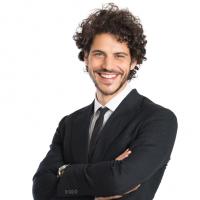 אופיר מאגדיMathematics teacher₪200 / hourתל אביב -יפופרונטלי+ZOOM. הכנה מהירה ותכליתית לבחינה! מורה פרטי מצוין!!! רק למקצועות: המימון, ניהול פיננסי, שוק ההון ושמאות מקרקעין. יש מאות המלצות!Full profile
 אבירם יעקביאןMathematics teacher₪230 / hourראשון לציוןבוגר מתמטיקה בהצטיינות מהטכניון, מרצה ומתרגל מצטיין. בעל ניסיון עשיר ורב שנים. מלמד מתמטיקה בגובה העיניים, סבלני ואיכפתי:)Full profile
 יוחאי אMathematics teacherרמת גןסטטיסטיקאי ומוסמך MBA מסייע בעיבודים סטטיסטיים ומעביר שיעורים פרטיים (ליחיד או לקבוצות קטנות).Full profile
 שי קמחיMathematics teacher₪200 / hourחיפהבוגר תואר שני עם שנות ניסיון בהוראה , רצון גדול להוביל להצלחות. .Full profile
 בנימין דוידובMathematics teacher₪120 / hourאשקלוןמורה פרטי למתמטיקה/פיזיקה מזה כשבע שנים המלמד בצפון ובדרום - מגיש לבגרויות בכל הרמות טלפון - **********Full profile
 יובל שפיראMathematics teacher₪80 / hourעתליתיובל, בת 23 מעתלית, בוגרת 5 יח״ל מתמטיקה בציון 95, בעלת ניסיון בהדרכה והוראה. מציעה תגבור, הכנה למבחנים וחיזוק הבסיס. סבלנית, אחראית וניידת עם רכב 😊Full profile
About Mathematics
Math here follows the Israeli school years, one step at a time. Young children count to five on their fingers, find one more and one less, and name circles, squares and triangles. In grades 1 to 6 they work with numbers to 20 and to 100, multiplication and division, fractions, decimals and percentages, and the area and perimeter of a shape.
From grade 7, letters join the numbers. Students solve linear equations, then quadratic equations, and meet the Pythagorean theorem and trigonometry in the right triangle. High school brings probability, derivatives, and the bagrut courses at three, four and five units. For first-year university there are single-variable calculus, linear algebra, and statistics and inference.
Every topic is a live lesson with Lessi, an AI teacher. Lessi explains on a board, out loud, stops for short quizzes, and moves at the student's pace. When a homework question gets stuck, Ask Lessi can answer it. The first 60 minutes are free with an account, and the topic pages have free printable worksheets.
Common questions
What ages is the math here for?
From age 3 to university. The early years start with counting and shapes for ages 3 to 5. Then every school year from grade 1 to grade 12 has its own topics, from numbers to 20 up to the bagrut courses. First-year university students will find calculus, linear algebra, and statistics and inference.
Can my child learn algebra online with Lessi?
Yes. Algebra starts in grade 7 with turning words into expressions and solving linear equations with the balance principle. In grade 9 it moves on to factoring, the quadratic formula and the parabola. Lessi teaches each step live, on a board and out loud, and checks understanding with short quizzes before going on.
Are there free math worksheets?
Yes. Each math topic page has free printable worksheets, so a child can practice on paper away from the screen. They follow the same topics as the lessons, from counting and times tables to fractions, equations and trigonometry.
Does it help with the math bagrut?
There are courses for the math bagrut at three and four units in grade 11 and at five units in grade 12. They cover topics such as sequences, the sine and cosine rules, investigating a function through its derivative, trigonometric equations and the natural logarithm. Lessi works through them with the student, at the student's pace.
How much does it cost to try?
The first 60 minutes of lessons with Lessi are free with an account. Ask Lessi answers math questions free with an account too, from the same free minutes. The printable worksheets on the topic pages are free.